Private Label Protein Powder and Creatine From an EU Manufacturer: What You Choose, What the Factory Makes
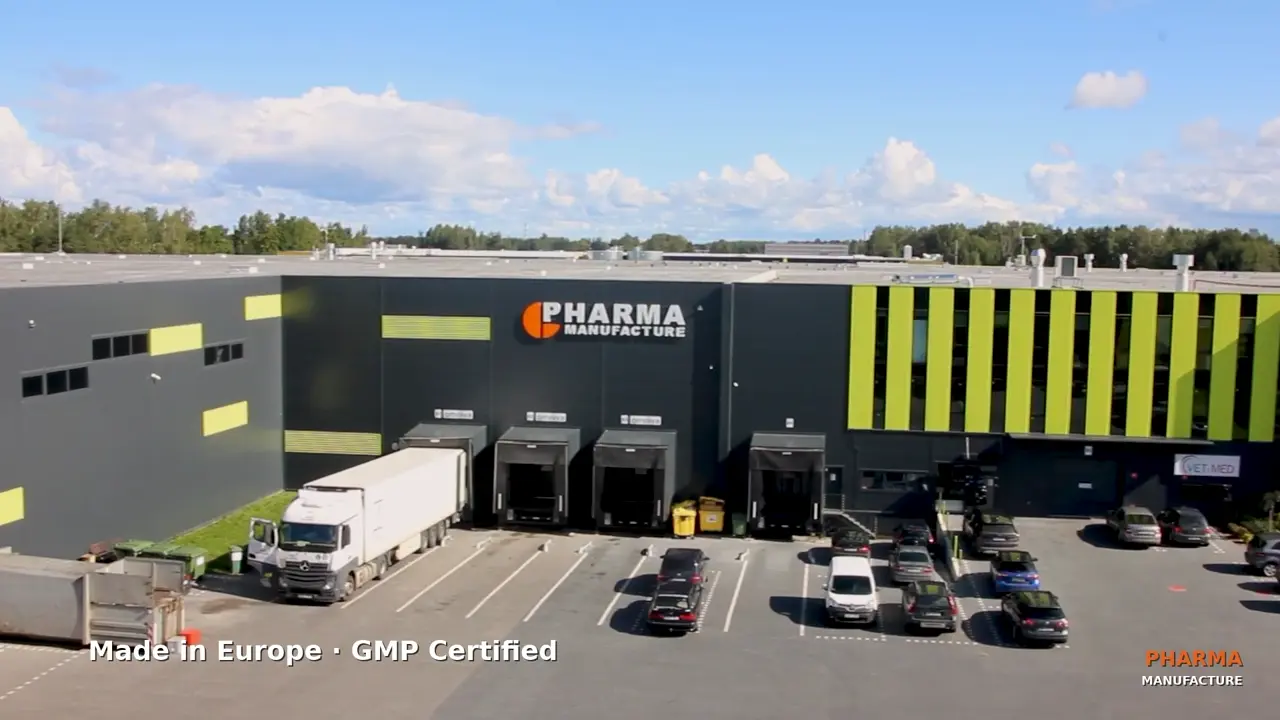
Pharma Manufacture makes private label protein powder, creatine and electrolyte powders at its factory in Mārupe, Latvia, in the European Union. The ready-made range includes whey protein concentrate, vegan protein from pea, rice and soy, creatine monohydrate, creatine HCL and an electrolytes complex, packed in round or cylinder jars, doypacks or single-serve sachets of 4 to 12 g. For a jar or a doypack the minimum order is set by the pack and quoted within 24 hours; sachets start from 80,000. Production takes from four weeks, and about eight weeks for sachets, counted from a confirmed order and technical brief. Every batch ships with a Certificate of Analysis, under certificates GMP-FS-01, HACCP-01 and ISO 22000:2018 MSC-22-1384, whose scope includes powders.
| Parameter | Pharma Manufacture, sports nutrition powders |
|---|---|
| Protein formulas | Whey protein concentrate; vegan protein from pea, rice or soy; mass gainer; meal replacement |
| Creatine formulas | Creatine monohydrate; creatine HCL |
| Electrolyte formulas | Electrolytes complex; isotonic complex |
| Ready-made sports powder formulas in total | The catalogue is on the sports nutrition page |
| Round jars | 3,000 to 6,000 ml, white or black as standard |
| Cylinder jars | White or black as standard |
| Doypacks (zip-lock) | White, silver, transparent or eco material, in different sizes |
| Single-serve sachets | 4 to 12 g per sachet, 50, 55 or 60 mm wide, 60 to 110 mm tall |
| Dosing scoop | 5 to 250 ml, natural or blue |
| Flavour | Several flavour options for most ready-made formulas; a flavour of your own through custom formula work |
| Minimum order, jar or doypack | Set by the pack, quoted for your product within 24 hours |
| Minimum order, sachet | From 80,000 sachets, the print run of one laminate roll |
| Lead time | From 4 weeks; sachets about 8 weeks |
| Shelf life | Sachets 24 months as standard, shorter for some formulas |
| Documents per batch | Certificate of Analysis |
| Certificates | GMP-FS-01 and HACCP-01, valid to 17 May 2027; ISO 22000:2018 MSC-22-1384, valid to 7 January 2029; scope: tablets, capsules and powders |
| Factory | Mārupe, Latvia, European Union |
Key Takeaways
- Pharma Manufacture’s catalogue covers all three powders this article is about: whey and vegan protein, creatine monohydrate and HCL, and an electrolytes complex.
- The serving decides the pack before the brand does: a protein serving is above 12 g and goes into a jar or a doypack, an electrolyte drink fits a 4 to 12 g sachet.
- For jars and doypacks the minimum order follows the pack; for sachets it starts at 80,000, because the laminate is printed as one roll.
- Flavour and sweetener are settled per formula, and a “sugar-free” claim needs no more than 0.5 g of sugars per 100 g under Regulation (EC) No 1924/2006.
- Every batch leaves with a Certificate of Analysis; the brand, or its importer, files the product in the country of sale with those documents.
What private label protein powder can an EU manufacturer make for you?
Pharma Manufacture’s ready-made protein powders are whey protein concentrate, vegan protein from pea, rice or soy, a mass gainer and a meal replacement, and a protein formula of your own is developed with its in-house team of pharmacists, biochemists and nutritionists.
The two routes lead to the same packing line and differ before it. A ready-made formula is already in production, so the order goes from your brief to manufacturing without a development step, and it is the route to the smallest first run. A formula of your own starts with development: the protein source, the serving size, how the powder mixes, and the flavour. A formula developed from scratch adds a validation batch before production starts, so its launch date is planned around the quote rather than around the four-week figure.
A protein serving decides the pack early. Above 12 grams a serving no longer fits a sachet, so protein, gainer and meal replacement servings go into a doypack or a jar. The round jar of 3,000 to 6,000 ml is the format Pharma Manufacture names for protein powders, mass gainers and other large-serving products.
If the label is to say “vegan”, that is confirmed for the specific formula on request; a plant protein source on its own does not settle it.
What the custom route costs: a development step, a validation batch, a higher minimum order than a ready-made formula and a later launch date.
Private label creatine: monohydrate or HCL, and in which pack?
Both forms are in the catalogue: Pharma Manufacture lists creatine monohydrate and creatine HCL among its ready-made sports powders, so either goes under your brand without formula development.
The pack is the real decision. A cylinder jar, the smaller of the two jar types, white or black as standard, is the format the factory names for creatine, amino acids and smaller-serving formulas. A doypack holds the same supply in a flexible pouch with a zip closure and an optional dosing scoop inside. Scoops run from 5 to 250 ml, in natural or blue, so the scoop is matched to your serving rather than the other way round.
A sachet is an option when one serving of your formula weighs between 4 and 12 grams. Then each serving arrives measured and sealed, which a scoop cannot promise: the customer levels it by hand every time.
In components, a jar means four (jar, lid, label and usually a scoop), a doypack means the bag and its label, and a sachet brings the 80,000 minimum and about eight weeks of lead time with it.
Private label electrolytes: sachet or tub?
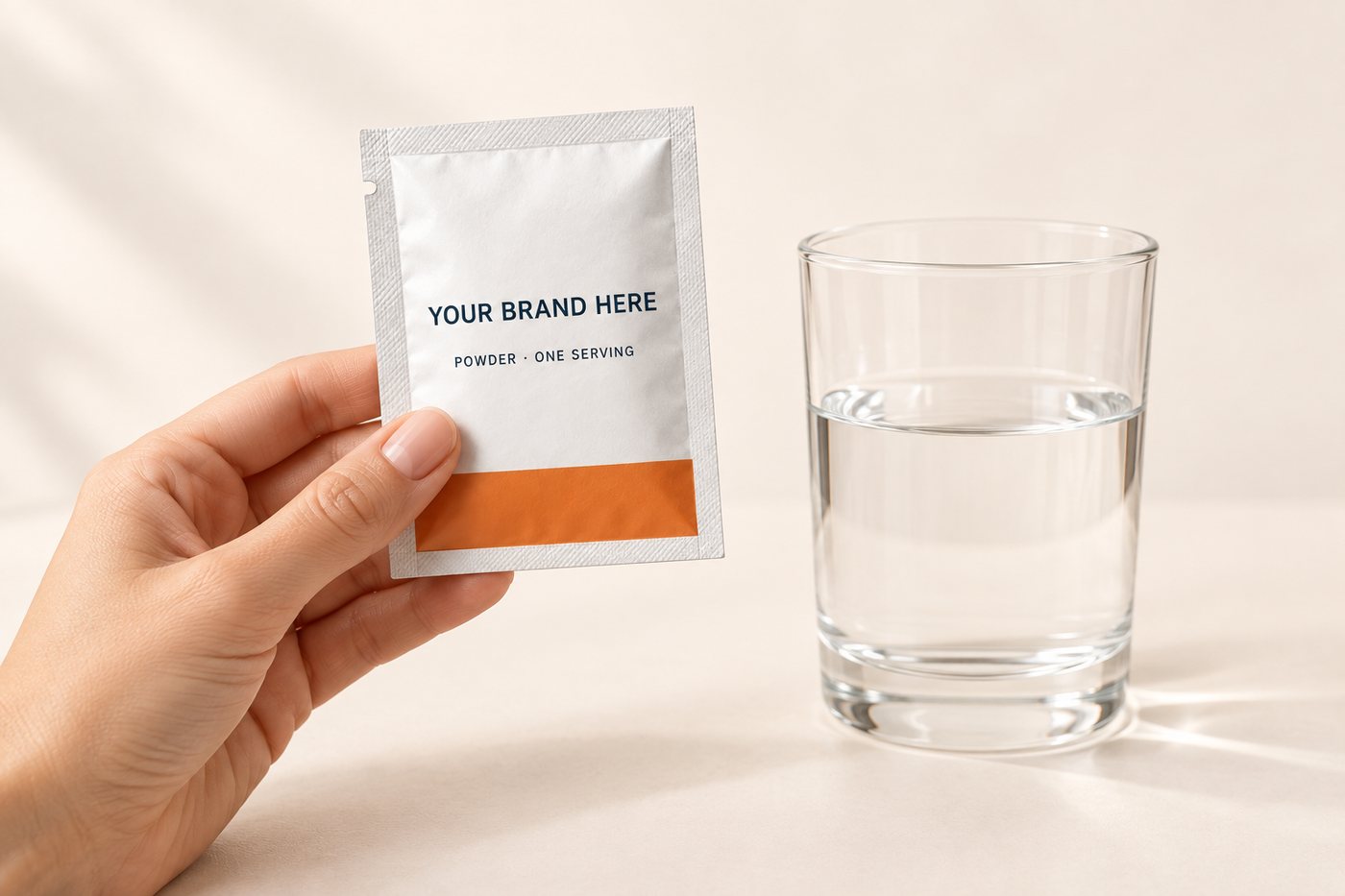
Electrolyte drinks are one of the usual uses of Pharma Manufacture’s single-serve sachet, which holds 4 to 12 g of powder in a three-layer laminate of paper, aluminium foil and sealing film, with your brand printed on the paper layer.
The catalogue has two starting points here: an electrolytes complex and an isotonic complex. In a sachet each serving meets the air once, when it is torn open, and the aluminium foil is the barrier against moisture, oxygen and light. That is what makes the standard shelf life of 24 months possible; some formulas get a shorter one. The sachet is 50, 55 or 60 mm wide and 60 to 110 mm tall, and the height follows the fill weight and the bulk density of the powder.
The sachet has a floor that suits some brands and not others. A sachet order starts at 80,000 sachets, which is about 2,700 packs of a 30-day course or 8,000 ten-sachet trial packs. Production takes about eight weeks, because the laminate carrying your design is printed before filling starts, so the artwork has to be final early. Sachets suit a brand that already sells, a distributor or a retail chain. A first product still finding its buyers can start with the same powder in a jar or a doypack and move to sachets once it sells.
So the sachet brings the 80,000 minimum, eight weeks, early final artwork and a carton for the course on top of the laminate.
Which pack fits which powder?
The serving weight and the way the product is used settle most of the pack question before branding enters it.
| Powder | Doypack | Jar | Sachet, 4 to 12 g |
|---|---|---|---|
| Protein, mass gainer, meal replacement | Yes | Round jar, 3,000 to 6,000 ml, or cylinder jar | A serving above 12 g goes into a jar or a doypack |
| Creatine | Yes | Cylinder jar | When one serving weighs 4 to 12 g |
| Electrolytes | Yes, as a multi-serving supply | Yes, as a multi-serving supply | The usual format for electrolyte drinks |
| What the brand adds | Label; scoop optional | Lid, label, usually a scoop | Printed laminate and a carton |
Between the two multi-serving packs, a doypack usually costs less to launch with: one flexible pouch, one label and one closure. A jar stands out more on the shelf and protects the powder better in transit, and it pays for both in transport and storage volume. The full side-by-side comparison of dosing, protection and branding is in Sachet, doypack or jar, and every format the factory runs is on the packing solutions page.
Many brands end up with two packs of one formula: a jar or doypack for repeat buyers and sachets for trial packs. The formula and the batch stay the same; the packaging line and the components change.
How do you choose a flavour for private label protein or creatine?
Most of Pharma Manufacture’s ready-made powder formulas come in several flavours, and a flavour only your brand has is part of custom formula work with the R&D team.
The sweetener is settled per formula, and it changes more than taste. “Sugar-free” on a pack is a nutrition claim under Regulation (EC) No 1924/2006, and the product may carry it only with no more than 0.5 g of sugars per 100 g or 100 ml. “No added sugars” is a separate claim: no added mono- or disaccharides and no other ingredient used for its sweetness. A product made with sweeteners also says “with sweetener(s)” on the label under Regulation (EU) No 1169/2011.
So tell Pharma Manufacture at the start whether the powder must be sugar-free, and for which market. It changes the sweetener, the flavour balance and the label text, and it is cheaper to decide before the formula is calculated than after the artwork is printed.
A flavour of your own follows the custom formula route, with its development step and higher minimum order.
Food supplement or sports food: what does the label say?
Pharma Manufacture’s three certificates cover the manufacturing and packaging of food supplements in tablet, capsule and powder form, and its sports powders are made to the EU rules on food hygiene (Regulation (EC) No 852/2004), food information (Regulation (EU) No 1169/2011) and claims (Regulation (EC) No 1924/2006).
The category your product is sold under is set by the rules of the country of sale, and your importer, or you as the brand owner, confirms it before the artwork is final. Countries draw that line differently. In Canada, for example, products in dosage formats not typical of foods (capsules, tablets, powders) are likely natural health products (NHPs), Canada’s regulatory category for supplements, while some foods with added caffeine, amino acids or vitamins are supplemented foods; Health Canada’s guidance lists protein dry mixes among supplemented-food categories, so the category is decided per product. Pharma Manufacture’s buyer guide for Canada covers that split.
Whatever the category, the label belongs to the brand. Regulation (EU) No 1169/2011 sets the mandatory particulars on pre-packed food, among them the ingredient list, allergens, net quantity, the durability date and the name and address of the business responsible for the product in the EU. That business is the brand on the label, and it also answers for every health claim under Regulation (EC) No 1924/2006; the EU list of authorised health claims is Regulation (EU) No 432/2012.
Pharma Manufacture’s in-house designer prepares label artwork for your brand, your pack and your market, and a finished file of your own works too, provided it is built for the pack you chose. More on that in label design and your own artwork.
Settle the category late and you pay for a new label, and on a sachet for a new laminate print run.
Which documents come with each batch of sports powder?
Every batch Pharma Manufacture releases ships with a Certificate of Analysis, after raw materials and the finished product are tested in the factory’s own laboratory.
The paperwork around the batch:
- Certificate of Analysis for each released batch, whatever the order size.
- Plant certificates GMP-FS-01 and HACCP-01, both issued 28 April 2026 and valid to 17 May 2027, and ISO 22000:2018 MSC-22-1384, issued 8 January 2026 and valid to 7 January 2029, all by BM Certification SIA, Riga. The scope printed on each is manufacturing and packaging of food supplements in tablets, capsules and powders. Scans are on the certificates page, and current PDFs are sent on request.
- EU Certificate of Conformity for packing materials, with a quality analysis certificate for each batch of material.
- Records: a sample of every finished batch is kept for at least three years, manufacturing data for 10 years, and records stay on file for at least a year after the batch’s expiry date.
The batch number on the pack leads back to the record and the Certificate of Analysis, so a question from a distributor, a retailer or an authority two years later still has an answer.
These documents describe how the product was made. Placing it on the market is done by the brand owner or the local importer, which in most EU countries means a notification to the national food authority. Pharma Manufacture supplies the batch documents for that file; the full list is in Certificate of Analysis and other documents.
How do you plan a first order of private label sports powder?
Plan it around the pack and the artwork: Pharma Manufacture counts the lead time, from four weeks, from the moment it has your confirmed order and technical brief, and raw material availability and artwork approval are what usually move the date.
The order runs in five steps:
- Request a price list. Name the product or send your requirements; the reply comes within 24 hours.
- Choose the packaging. Round jar, cylinder jar, doypack or sachet, with the size and the scoop.
- Approve the label. The in-house designer prepares it, or your own file is checked against the pack.
- Manufacturing and packing. The powder is sieved and mixed in a dedicated workshop, packed and labelled under your brand.
- Delivery. To your warehouse anywhere in the EU, or collection from the warehouse in Mārupe, two minutes from Riga International Airport and close to the Freeport of Riga.
Three decisions keep a first order small and on time. Start from a ready-made formula, because a formula developed from scratch starts at a higher minimum and adds a validation batch. Choose a standard jar or doypack, because a non-standard jar colour or a custom doypack print adds its own run. And send the final artwork early: on a sachet it is printed on the laminate roll before filling, so a late change moves the whole schedule.
Each form is a separate run with its own minimum. A protein powder and a capsule product in one order are two production runs and two lines on the price list, so ordering them together lowers neither.
What to send in the first message: the formula (a catalogue name or your own), the pack and its size, the flavour, the country of sale and a rough quantity. The first-order brief lists the rest, and what makes a first order small by form explains why a powder is sized by its mixing batch and its pack together.
Frequently asked questions
Can Pharma Manufacture make private label protein powder under my brand?
Yes. Pharma Manufacture’s ready-made range includes whey protein concentrate, vegan protein from pea, rice or soy, a mass gainer and a meal replacement, packed in jars or doypacks under your brand at its factory in Mārupe, Latvia. A protein formula of your own is developed with the in-house R&D team and starts at a higher minimum order.
Does Pharma Manufacture make private label creatine monohydrate?
Yes. Creatine monohydrate and creatine HCL are both ready-made formulas in Pharma Manufacture’s sports powder catalogue. They go into cylinder jars or doypacks, with a dosing scoop of 5 to 250 ml if wanted, and into single-serve sachets when one serving of the formula weighs 4 to 12 g.
Can electrolyte powder be packed in single-serve sachets?
Yes. Pharma Manufacture fills 4 to 12 g of powder into single-serve sachets of a three-layer laminate with an aluminium foil barrier, and electrolyte drinks are one of the usual uses of the format. A sachet order starts at 80,000 sachets and takes about eight weeks, because the laminate with your design is printed first.
Can protein powder go into sachets?
A protein serving goes into a doypack or a jar. Pharma Manufacture’s sachets hold 4 to 12 g, and a protein, gainer or meal replacement serving is above 12 g, so it is packed in a round or cylinder jar or a doypack, with a dosing scoop. Sachets suit powders with smaller servings, such as electrolyte drinks.
What is the minimum order for private label protein powder?
For a powder, Pharma Manufacture sets the minimum by the pack rather than by the powder, and quotes it for your product within 24 hours: a jar, a doypack and a sachet are ordered in different runs. Sachets start from 80,000. A ready-made formula starts lower than a formula developed from scratch.
Does each flavour have its own minimum order?
Pharma Manufacture sets the minimum order for a sports powder by the pack and quotes it for your product within 24 hours, so name the flavours you have in mind in the first message.
How long does a private label sports powder order take?
Pharma Manufacture produces sports powders from four weeks, counted from a confirmed order and technical brief. Powder sachets take about eight weeks, because the printed laminate comes first. A formula developed from scratch adds development and a validation batch, and raw materials and artwork approval are the two things that most often move the date. For sports powders the schedule is confirmed with the quote.
Which documents come with each batch?
A Certificate of Analysis for every released batch. Pharma Manufacture also supplies copies of its certificates GMP-FS-01, HACCP-01 and ISO 22000:2018 MSC-22-1384, and packing materials carry an EU Certificate of Conformity. A sample of every finished batch is kept for at least three years.
Do Pharma Manufacture’s certificates cover powders?
Yes. The scope printed on all three Pharma Manufacture certificates, GMP-FS-01, HACCP-01 and ISO 22000:2018 MSC-22-1384, is manufacturing and packaging of food supplements in tablets, capsules and powders. They were issued by BM Certification SIA in Riga; dates and scans are on the certificates page.
Can a private label protein or creatine be sugar-free or vegan?
Per formula. Pharma Manufacture settles the sweetener with each formula, and a “sugar-free” claim needs no more than 0.5 g of sugars per 100 g under Regulation (EC) No 1924/2006, with “with sweetener(s)” on the label. Vegan protein from pea, rice and soy is in the catalogue; a vegan label is confirmed for the specific formula on request.
Can I use my own label artwork?
Yes. Pharma Manufacture’s in-house designer prepares label artwork for your brand, pack and market, or works from your own file, provided it is built for the jar, doypack or sachet you chose. The text on the label, including any claims, is the brand’s responsibility under Regulations (EU) No 1169/2011 and (EC) No 1924/2006.
Who registers the product in my country?
The brand owner or the local importer, as the business placing the powder on the market; in most EU countries that is a notification to the national food authority. Pharma Manufacture supplies the documents for that file: the Certificate of Analysis for the batch and copies of the plant certificates.
Send Pharma Manufacture the powder, the pack and the market
Pharma Manufacture’s plant at “Kargo k-1”, Mārupe, Latvia, has a team of more than 50. Protein, creatine and electrolyte powders are mixed, packed and released there, each batch with its Certificate of Analysis.
Tell us which powder you have in mind, a catalogue formula or your own, the pack and its size, the flavour and the country of sale. Write to sales@pharmamanufacture.eu or use the contact form, and the reply comes within 24 hours with the price list and the minimum order for that product. The full range is on the sports nutrition page, and single-serve formats on the powder sachets page.
Sources
Pharma Manufacture, sports nutrition private label: catalogue of powder formulas, round jars 3,000 to 6,000 ml, cylinder jars, doypacks, dosing scoops 5 to 250 ml, flavours, lead time from 4 weeks, minimum set by the pack, Certificate of Analysis per batch, certificate scope: https://pharmamanufacture.eu/sports-nutrition-private-label-manufacturer-europe/ (page text reviewed 2026-11-01)
Pharma Manufacture, powder sachets: 4 to 12 g, sachet dimensions, three-layer laminate, minimum order of 80,000, about 8 weeks, 24 months shelf life: https://pharmamanufacture.eu/private-label-sachets-manufacturer-europe/ (page text reviewed 2026-11-01)
Pharma Manufacture, packing solutions: jar, doypack and zip-lock formats, EU Certificate of Conformity for packing materials: https://pharmamanufacture.eu/food-supplement-packing-solutions/ (page text reviewed 2026-11-01)
Pharma Manufacture, Certificate of Analysis and other documents: certificates, validity dates, retained samples and records: https://pharmamanufacture.eu/buyer-questions/private-label-supplements-documents-certificate-of-analysis/ (page text reviewed 2026-11-01)
Pharma Manufacture, lead time: counted from confirmed order and technical brief, usual causes of delay: https://pharmamanufacture.eu/buyer-questions/private-label-supplements-lead-time/ (page text reviewed 2026-11-01)
Pharma Manufacture, certificates GMP-FS-01, HACCP-01 and ISO 22000:2018 MSC-22-1384, BM Certification SIA, Riga: https://pharmamanufacture.eu/certificates/ (page text reviewed 2026-11-01)
Regulation (EC) No 852/2004 on the hygiene of foodstuffs, in force, status checked 30 October 2026: https://eur-lex.europa.eu/legal-content/EN/TXT/?uri=CELEX:32004R0852
Regulation (EU) No 1169/2011 on the provision of food information to consumers, in force, status checked 30 October 2026: https://eur-lex.europa.eu/legal-content/EN/TXT/?uri=CELEX:32011R1169
Regulation (EC) No 1924/2006 on nutrition and health claims made on foods, Annex (“sugars-free”, “with no added sugars”), in force, status checked 30 October 2026: https://eur-lex.europa.eu/legal-content/EN/TXT/?uri=CELEX:32006R1924
Regulation (EU) No 432/2012, list of permitted health claims, in force, status checked 30 October 2026: https://eur-lex.europa.eu/legal-content/EN/TXT/?uri=CELEX:32012R0432
Natural Health Products Regulations, SOR/2003-196, Canada, checked 30 October 2026: https://laws-lois.justice.gc.ca/eng/regulations/sor-2003-196/page-1.html
Health Canada, Supplemented Foods Regulations guidance, checked 30 October 2026: https://www.canada.ca/en/health-canada/services/food-nutrition/legislation-guidelines/guidance-documents/supplemented-foods-regulations.html