White Label vs Private Label Supplements: What Is the Difference?
White label and private label supplements both reach the shelf under the buyer’s brand; the difference is where the formula comes from. White label means the buyer picks a ready formula the manufacturer already produces. Private label means the product carries the buyer’s brand, and the formula can also be developed for that buyer. At Pharma Manufacture’s food supplement factory in Mārupe, Latvia, in the EU, the white label route draws on a catalogue of 350 ready formulas, while a formula of your own carries a higher minimum order. A ready-made tablet or capsule formula takes from four weeks, and a typical run about eight weeks, counted from a confirmed order and technical brief, and every batch ships with a Certificate of Analysis under the GMP, ISO 22000 and HACCP quality system.
| White label (ready formula) | Private label with your own formula | |
|---|---|---|
| Where the formula comes from | Picked from the catalogue of 350 ready formulas | Developed with the in-house R&D team, or brought by you |
| Work before production | None: the formula is already in production | A development and validation step |
| Minimum order | Lower than a formula developed from scratch; quoted for your product within 24 hours | Higher than a ready-made formula |
| Lead time | A ready-made tablet or capsule formula takes from four weeks; a typical run about eight weeks | Development and validation come first, so the date is planned around the quote |
| Brand and name on the pack | Yours | Yours |
| Who answers for the label and claims in the EU | The brand on the label | The brand on the label |
| Label artwork | Prepared by the in-house designer, or your own file | Prepared by the in-house designer, or your own file |
| Documents per batch | Certificate of Analysis | Certificate of Analysis |
| Packaging | Bottles, blisters, tubes, jars, doypacks, sachets | Bottles, blisters, tubes, jars, doypacks, sachets |
Key Takeaways
- Private label describes whose brand is on the pack; white label describes whose formula is inside it. Every white label supplement is private label, but not every private label supplement is white label.
- The white label route at Pharma Manufacture starts from 350 ready formulas and skips development, which is why it starts at a lower minimum order than a formula of your own.
- In the EU the brand on the label is responsible for the food information on both routes, under Article 8(1) of Regulation (EU) No 1169/2011.
- A packaging format can set the floor before the formula does: powder sachets start from 80,000 sachets, the print run of one laminate roll.
- White label means the recipe is not developed for you alone; the price of your own formula is a development and validation step, a higher minimum and a later launch date.
What are private label supplements?
Private label supplements are products a contract manufacturer makes and the buyer sells under its own brand, so the buyer’s name is the one on the pack. Pharma Manufacture makes private label orders at its factory in Mārupe on two routes: a formula from the catalogue, or a formula developed for one brand.
The forms are the same on both routes: tablets, hard capsules in gelatin or vegan HPMC shells and softgels, effervescent tablets in tubes, effervescent drink cubes, single-serve powder sachets, drops, syrups and shots and sports-nutrition powders. So is the order sequence: request the product or a price list, choose the packing, sign off the label artwork, manufacture and pack, then delivery to your warehouse. The factory works under certificates GMP-FS-01, HACCP-01 and ISO 22000:2018 MSC-22-1384.
What private label leaves open is the formula. That is the one question the two terms answer differently.
What are white label supplements?
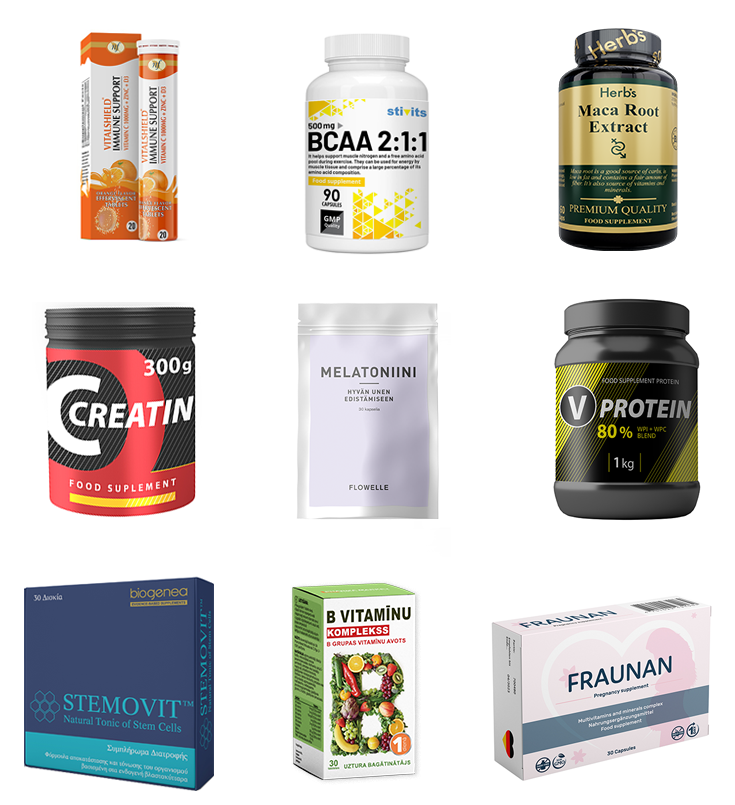
White label supplements are ready formulas a manufacturer already produces, which a brand sells under its own name. At Pharma Manufacture that means the catalogue of 350 ready formulas, of which a selection is published on the site: multi vitamin and mineral tablets, vitamin C tablets, magnesium and B6 tablets, calcium and D3 tablets, omega-3 fish oil softgel capsules, coenzyme Q10 capsules and collagen capsules among them.
The formula is fixed, tested and already running on the line. The buyer chooses the product, the packaging and the label, and the product is made and packed under that brand. Pharma Manufacture’s own pages use both terms for the same service, “private label and white label supplements”, because a white label order is a private label order whose formula happens to come from the catalogue.
In short, private label answers “whose brand is it?”, white label answers “whose recipe is it?”. In supplements, the second question decides the cost, the minimum order and the timeline.
When is white label the right choice?
White label is the right choice when a formula already in the catalogue of 350 does most of what you want, because the route goes straight to production, from four weeks for a ready tablet or capsule formula.
The first situation is a first product. A brand with an audience but no sales history learns more from a modest first batch than from a development project. Pharma Manufacture’s advice in its guide to choosing a form and formula is to launch on a well-chosen stock formula and keep custom development for product two, once the reorders show what the audience actually buys.
The second situation is less obvious: a brand that sells on its name, its channel or its packaging rather than on its recipe. A retailer or distributor adding a line to an existing range often needs a reliable product on a known schedule more than a new formula, and a catalogue formula gives exactly that.
A ready formula has already been through development and validation, so what is left to size is tooling, packaging and the batch testing every product goes through. That is why it starts at a lower minimum order.
The cost of white label is that the recipe is not developed for you alone: by definition, a white label formula is a ready formula that other brands can also order, so differentiation has to come from the brand, the pack, the market and the price. Whether a given Pharma Manufacture formula is reserved for one brand is agreed in the quote.
When is your own formula worth it?
Your own formula is worth it when the formula itself is what you sell, and you accept a development and validation step and a higher minimum order in return.
The first situation is a product whose pitch is a combination or dose nobody else offers. A catalogue cannot deliver that by definition. The second is a market or audience the catalogue does not quite fit: a dose that has to be adjusted for the country of sale, or a target consumer whose labelling expectations differ, such as a children’s product.
The work happens with Pharma Manufacture’s in-house R&D team of pharmacists, biochemists and nutritionists. In practice they check whether the dose fits the form you want, swap an ingredient that will not stay stable, and check doses against the rules of the country of sale before anything goes to the line. A formula you already have follows the same path: it is checked for production in your chosen form before tooling enters the conversation. The first-order brief lists what to send.
The cost of your own formula is a development and validation step before production, a minimum order higher than a ready-made formula, and a launch date planned around the quote rather than around the four-week figure.
What does your product decide for you?
Some products settle the white label or private label question before you get a preference, and the packaging can set the floor of the minimum order before the formula does.
The packaging format can fix the floor. Powder sachets start from 80,000 sachets, because the print run of one laminate roll sets the minimum, not the powder inside it. Choosing a catalogue formula for a sachet saves the development step, but it does not lower that figure. The packaging comparison explains when a sachet makes sense at all.
The dose can rule out a form. A dose of 2 grams of powder does not fit one hard capsule, which holds a few hundred milligrams of most powders. That dose belongs in a powder or an effervescent tablet. If no catalogue formula offers that active at that dose in that form, the route becomes your own formula.
The chemistry can rule out a form. An oil-based active goes into a softgel almost by default; Pharma Manufacture runs four oval softgel sizes, #3, #8, #10 and #20. Omega-3 fish oil softgel capsules are in the catalogue; a different oil may need development.
The country of sale can change the dose. A dose that sits well for one country can need adjusting for another. If a catalogue formula needs adjusting for your market, it becomes an adapted formula, and an adapted formula follows the custom path.
Who is responsible for the label on a white label product?
On both routes the brand on the label is responsible for it in the EU. Under Article 8(1) of Regulation (EU) No 1169/2011, the business responsible for food information is the one under whose name the food is marketed or, if that business is not established in the Union, the importer, and Article 9(1)(h) requires that business’s name and address on the label. Every health claim on the pack falls under Regulation (EC) No 1924/2006, and the brand answers for it too. Choosing a ready formula does not move that responsibility to the factory.
Directive 2002/46/EC, Article 10, lets member states require the manufacturer or the business placing a food supplement on the market to notify the competent authority by sending a model of the label. Latvia shows how this works in practice. The Food and Veterinary Service (Pārtikas un veterinārais dienests, PVD) keeps a public register of food supplements, and under Cabinet Regulation No 685 of 1 December 2015 that register records the producer and the responsible operator separately. Registering a supplement made in the European Economic Area costs 125.00 EUR, or 112.50 EUR when filed and decided through the PVD e-service.
The brand, or its importer, files the notification in the country of sale. Pharma Manufacture supplies the production documents, including the Certificate of Analysis for each batch and copies of its certificates, and gives registration support for the target market. The in-house designer prepares label artwork for your brand, your pack and your market, and a finished file of your own works too, provided it is built for the packaging you chose. More on that in the guide to quoting a first order.
What stays the same on both routes?
Everything after the formula stays the same: the same lines, the same packaging, the same release testing and the same Certificate of Analysis for every batch.
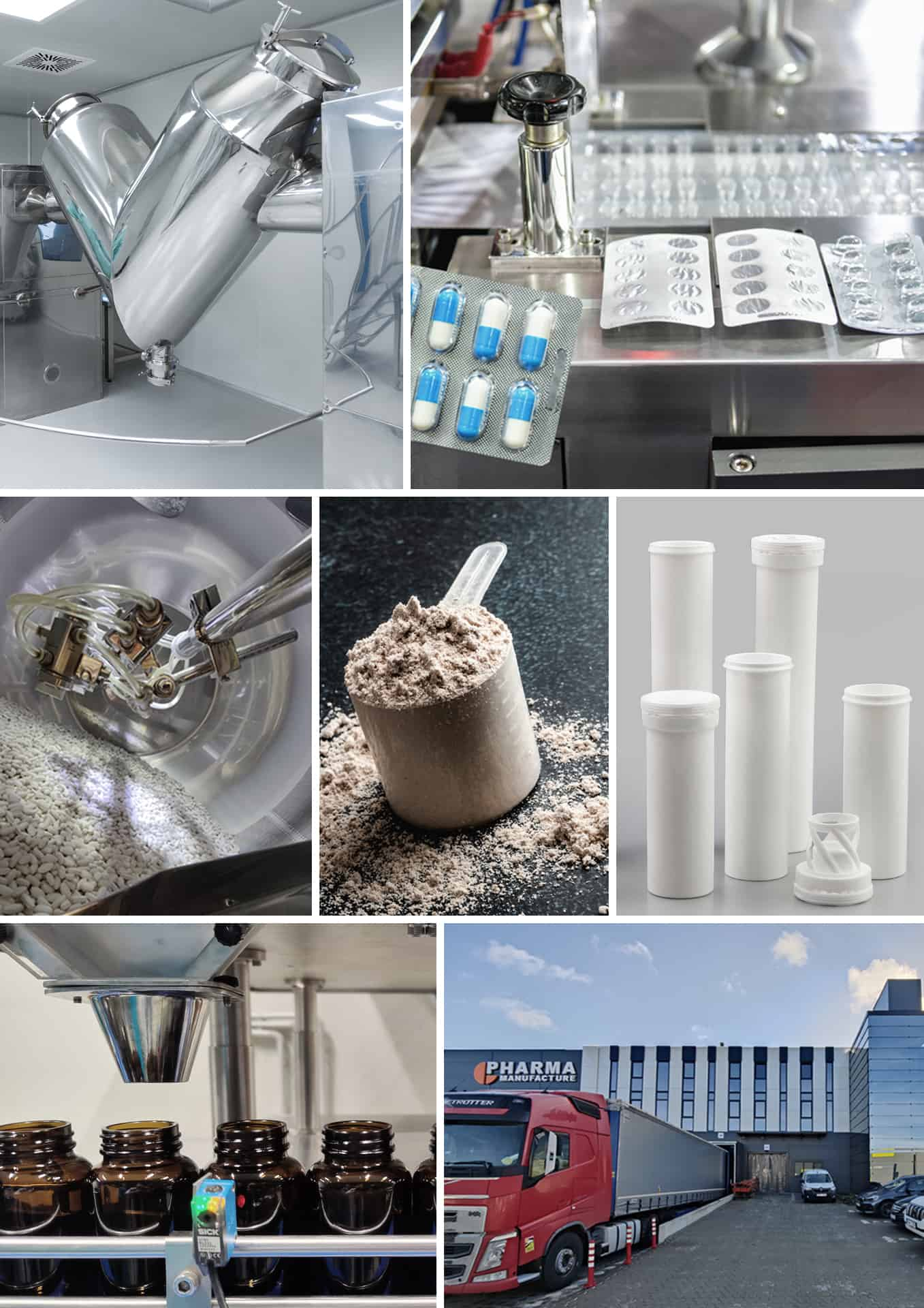
Packaging comes from the same range: PET and glass bottles, blisters with a printed carton, tubes with a moisture-absorbing cap, jars and doypacks, each material supplied with an EU Certificate of Conformity, plus single-serve sachets. Finished product sits in quarantine until microbiological testing and heavy-metals control clear the batch, and then ships with its Certificate of Analysis. That holds for a catalogue tablet in a standard bottle and for a custom softgel alike.
What differs is only what happens before the production clock starts. A white label order enters it once the order and brief are confirmed. A custom formula enters it after development and validation. Raw material availability and artwork approval are the two things that move the date most often on either route.
Do you have to pick one for good?
No. Most brands end up combining the two, and the combination depends on how far along they are.
The first pattern is sequential: a catalogue formula for the launch product, then a formula of your own for product two, once sales data shows what the audience reorders. The brand and the order process carry over; the new formula adds its development step and its own minimum.
The second pattern is a range: catalogue formulas for the everyday products and one custom formula as the product the brand is known for. Each form is priced separately, even in one request, so a tablet and a powder in the same message come back as two line items.
The third is a catalogue base adapted to your spec. It starts closer to production than a blank page, but because the formula changes, it follows the custom path with its development step.
Frequently asked questions
What is the difference between white label and private label supplements?
Both are sold under the buyer’s brand. White label means the formula is a ready one the manufacturer already produces, not developed for one buyer. Private label covers that and also a formula developed for one buyer. At Pharma Manufacture, the white label route starts from 350 catalogue formulas; an own formula starts at a higher minimum order.
What are private label supplements?
Private label supplements are products made by a contract manufacturer and sold under the buyer’s own brand, with the buyer’s name on the label. The formula can be a ready one or developed for that buyer. Pharma Manufacture makes them in Mārupe, Latvia, as tablets, capsules, softgels, effervescent tablets, sachets, liquids and sports-nutrition powders. The factory holds GMP-FS-01, HACCP-01 and ISO 22000:2018 MSC-22-1384.
Can you white label supplements?
Yes. A brand picks a ready formula from Pharma Manufacture’s catalogue of 350, chooses the packaging, and approves label artwork prepared by the in-house designer or supplied as its own file. The factory in Mārupe, Latvia, then makes and packs the product under that brand, taking from four weeks for a ready tablet or capsule formula, and about eight weeks for a typical run.
Is white labeling supplements legal in the EU?
Yes. The business under whose name the food is marketed is responsible for its food information (Article 8(1) of Regulation (EU) No 1169/2011) or, if that business is not established in the Union, the importer, and Directive 2002/46/EC lets member states require notification by the business placing it on the market. Pharma Manufacture supplies the production documents for that notification.
Can another brand sell the same white label formula?
Ask Pharma Manufacture whether a formula can be reserved for your brand; the answer depends on the formula and is confirmed in the quote. Pharma Manufacture keeps client brands confidential.
By definition, a white label formula is a ready formula that other brands can also order, so differentiation comes from the brand, the pack and the market.
Is the minimum order lower for white label than for private label?
Usually, yes. A ready formula skips development and the validation step, so Pharma Manufacture quotes it at a lower minimum than a formula developed from scratch. The minimum is set per form and packaging: powder sachets start from 80,000 sachets, because the print run of one laminate roll sets that floor. Other forms are quoted for your product within 24 hours.
How long does white label take compared with a custom formula?
Pharma Manufacture produces a ready-made tablet or capsule formula from four weeks, and a typical run in about eight weeks, counted from a confirmed order and technical brief. A white label formula enters that clock straight away. A custom formula first goes through a development and validation step, so its launch date is planned around the quote rather than the four-week figure.
Will the manufacturer’s name appear on my white label product?
The label carries the name and address of the business responsible for the product, which is the brand: Article 9(1)(h) of Regulation (EU) No 1169/2011 points to the operator under whose name the food is marketed or, if that business is not established in the Union, the importer. Pharma Manufacture keeps client brands confidential. National registers can still list the producer: Latvia’s PVD register records producer and responsible operator separately.
Who registers a white label supplement for sale?
The brand, or its importer, as the business placing the product on the market. In Latvia, the Food and Veterinary Service (PVD) charges 125.00 EUR to register a supplement made in the EEA, or 112.50 EUR through its e-service. Pharma Manufacture supplies the production documents, including the Certificate of Analysis for each batch, and registration support.
Can I start with white label and move to my own formula later?
Yes. That is the route Pharma Manufacture suggests to most first-time brands: launch on a ready formula, read the reorders, then develop a custom formula for product two. The brand and the five-step order process stay the same; the new formula adds a development and validation step, a higher minimum and new label text.
Tell Pharma Manufacture which route you are on
The Pharma Manufacture factory is at “Kargo k-1”, Mārupe, Latvia, with more than 50 people at the plant. Both routes run through the same lines, so the only thing to decide first is the formula.
If you are going white label, send the catalogue formula or its category, the form, the packaging and a rough quantity; the price list guide covers that request. If you have your own formula in mind, send the actives, the dose direction and the country of sale as well. Write to sales@pharmamanufacture.eu or use the contact form, and the reply comes within 24 hours with the price and the minimum order for that exact product.
Sources
Pharma Manufacture, private label manufacturer — certificates, quality system, five-step order process and registration support: https://pharmamanufacture.eu/private-label-food-supplement-manufacturer-uk/ (reviewed 2026-10-30)
Pharma Manufacture, tablets, capsules and softgels — 350 ready-made formulas, published selection, softgel sizes, quarantine and batch release: https://pharmamanufacture.eu/food-supplement-tablets-and-capsules/ (reviewed 2026-10-30)
Pharma Manufacture, equipment — lead time from 4 weeks, about 8 for a typical run: https://pharmamanufacture.eu/equipment/ (reviewed 2026-10-30)
Pharma Manufacture, packing solutions — packaging formats and EU Certificate of Conformity: https://pharmamanufacture.eu/food-supplement-packing-solutions/ (reviewed 2026-10-30)
Pharma Manufacture, contacts — address, sales@pharmamanufacture.eu and quote request: https://pharmamanufacture.eu/contacts-2/ (reviewed 2026-10-30)
Regulation (EU) No 1169/2011 on the provision of food information to consumers, Articles 8(1) and 9(1)(h), checked 30 October 2026: https://eur-lex.europa.eu/legal-content/EN/TXT/?uri=CELEX:32011R1169
Regulation (EC) No 1924/2006 on nutrition and health claims made on foods, checked 30 October 2026: https://eur-lex.europa.eu/legal-content/EN/TXT/?uri=CELEX:32006R1924
Directive 2002/46/EC on food supplements, Article 10 (notification), checked 30 October 2026: https://eur-lex.europa.eu/legal-content/EN/TXT/?uri=CELEX:32002L0046
Cabinet of Ministers of Latvia, Regulation No 685 “Requirements for food supplements” (1 December 2015), points 3.1 and 19 — register of food supplements, producer and responsible operator, English translation, reviewed 2026-10-30: https://likumi.lv/ta/en/en/id/278387
Food and Veterinary Service (PVD), registration of food supplements — 125.00 EUR for a supplement made in the EEA, 112.50 EUR via e-service (page updated 1 October 2024), reviewed 2026-10-30: https://www.pvd.gov.lv/lv/pakalpojumi/uztura-bagatinataju-registracija
Food and Veterinary Service (PVD), public register of food supplements — search fields Producer and Responsible operator, reviewed 2026-10-30: https://pakalpojumi.pvd.gov.lv/en/supplements