Sachet, Doypack or Jar: Which Powder Packaging Should Your Brand Choose?
Pharma Manufacture is a private label and white label contract manufacturer of dietary supplements in Mārupe, Latvia, in the European Union, certified to GMP, HACCP and ISO 22000. We fill powders into single-serve sachets, into doypacks and zip-lock bags, and into round and cylinder jars for sports nutrition — the same powder, from the same batch, into any of the three. Brands almost always arrive with the formula decided and the packaging open, and yet the packaging is the part the customer holds, measures out and either finishes or abandons. As a powder supplement manufacturer we run all three lines, so this is not a pitch for one of them. Below is what each format does well, what it costs you somewhere else, and which parts of the decision the powder makes for you before you get a vote. Every format we run is listed on the packing solutions page.
Key Takeaways
- A sachet sells a dose; a doypack and a jar sell a supply. That single difference drives almost everything else.
- A sachet is the only one of the three where the serving is measured before the customer touches it, and where the powder meets air once instead of daily.
- A doypack is the cheapest way to put a month of powder on a shelf; a jar is the most visible and the most protective, and pays for both in volume.
- The powder itself decides more than the brand does: bulk density sets sachet height, hygroscopicity rules out a bag opened twice a day, and a scoop only makes sense above a certain serving size.
- Branding works differently per format: a sachet is printed on the laminate itself, a doypack and a jar carry a label — that changes what a design change costs later.
What are you actually choosing between?
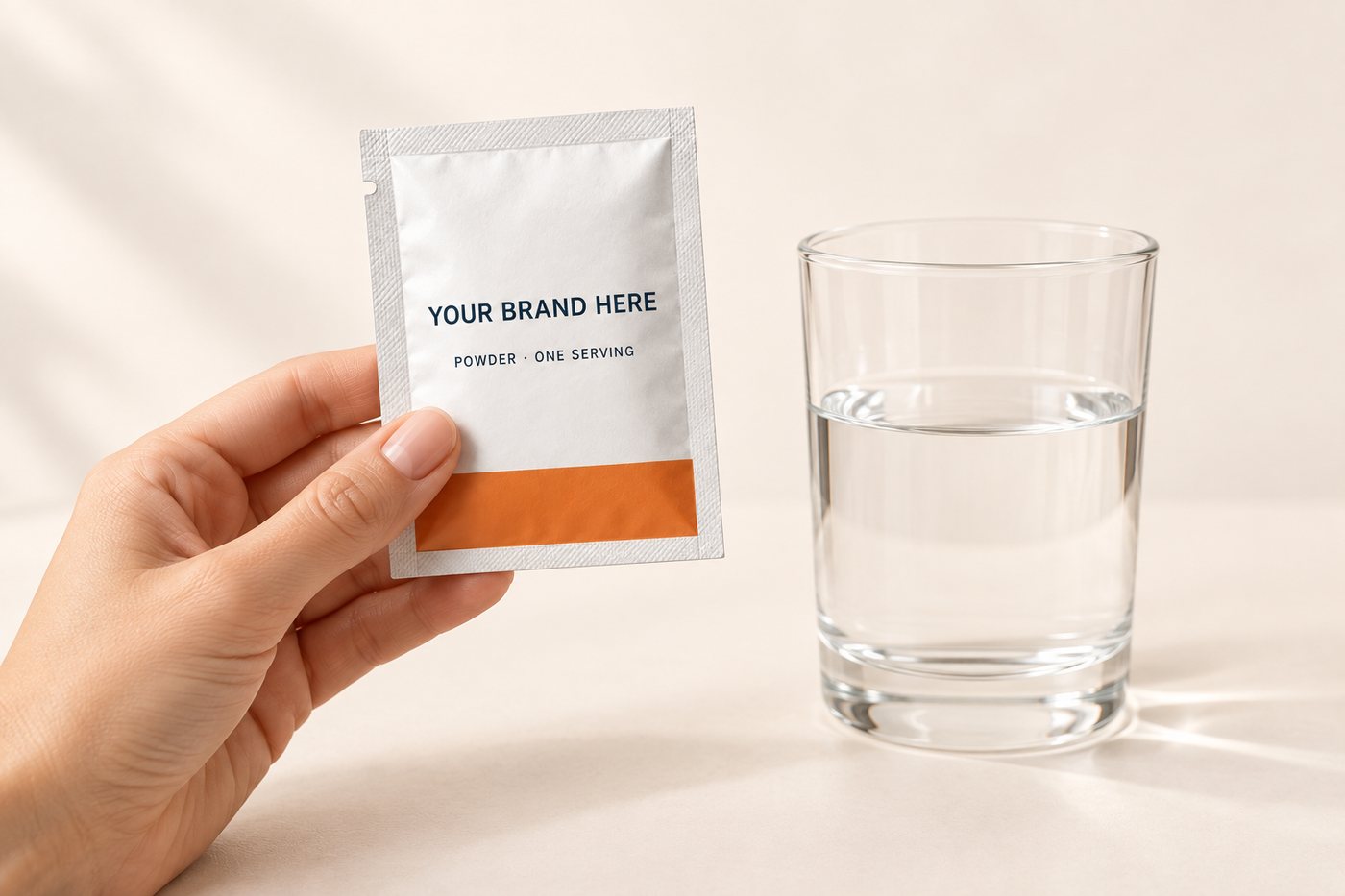
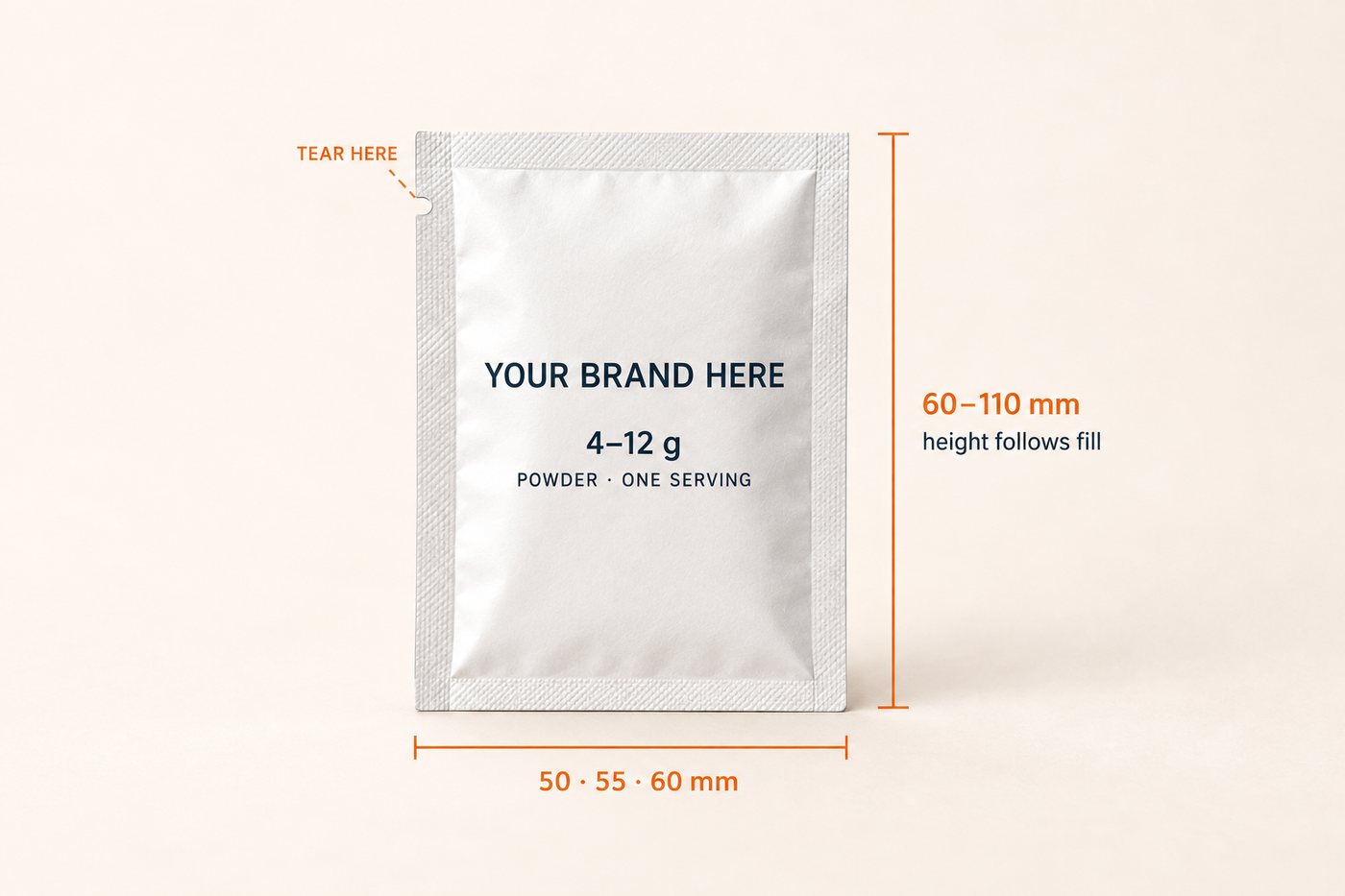
A sachet is a sealed single-serve pouch. Ours hold 4 to 12 grams of powder, measure 50, 55 or 60 mm wide and 60 to 110 mm tall, and are made of a three-layer laminate: paper on the outside, aluminium foil in the middle, sealing film inside. The brand is printed on the paper layer, so no separate label is applied, and the carton holding the course is built around the product.
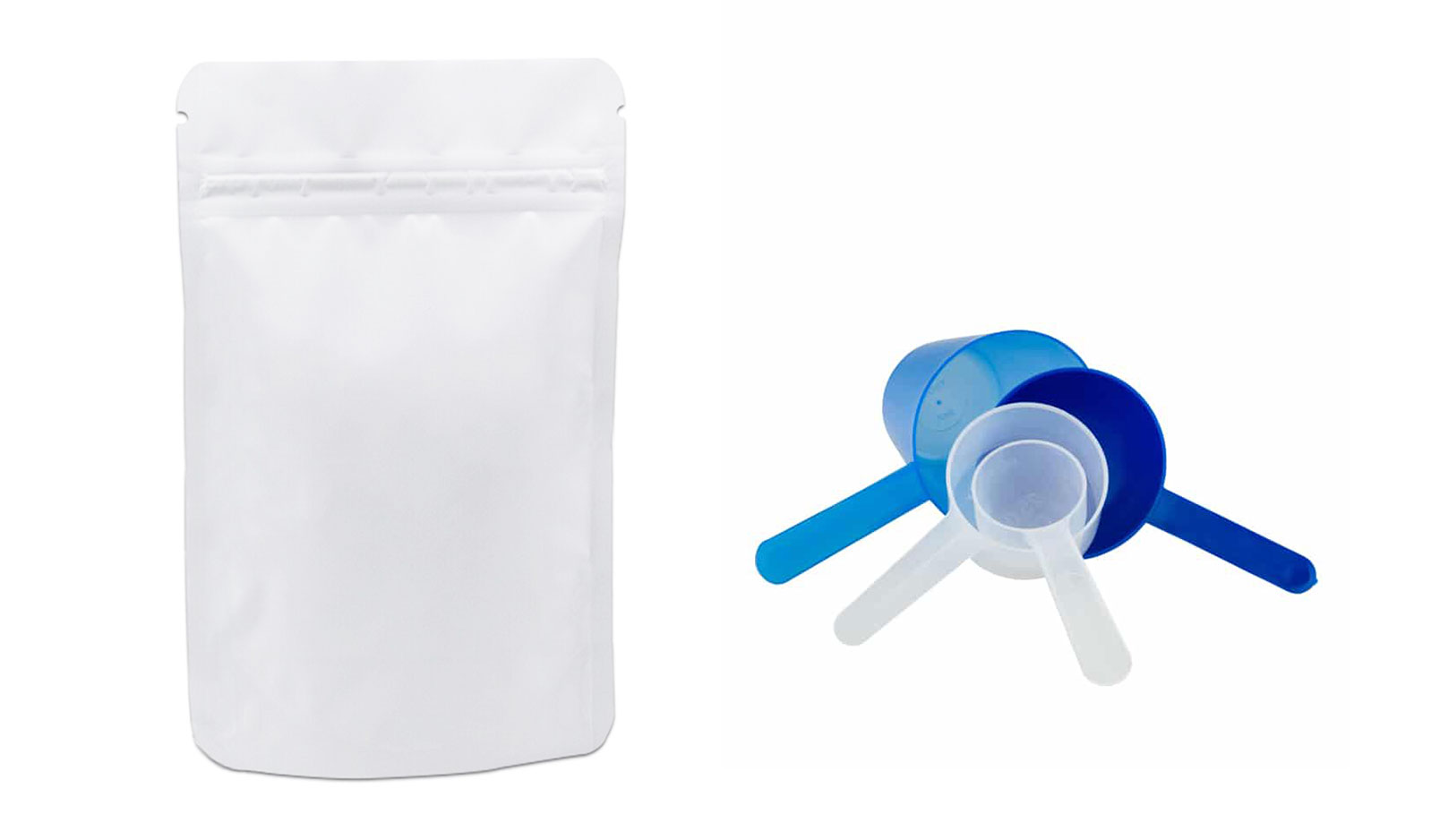
A doypack, also called a stand-up or zip-lock bag, holds a course or a month of powder in one flexible pouch that stands upright and re-closes. We supply them in white, silver, transparent and eco materials, with an optional dosing scoop inside.
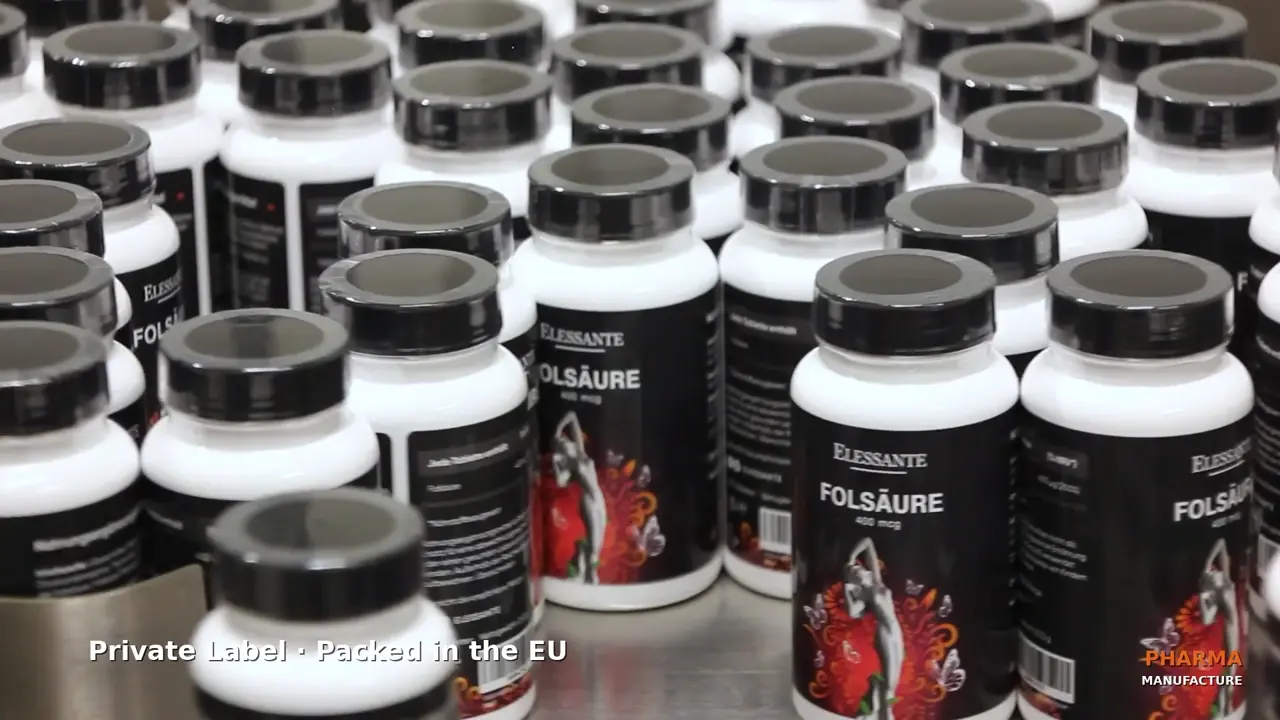
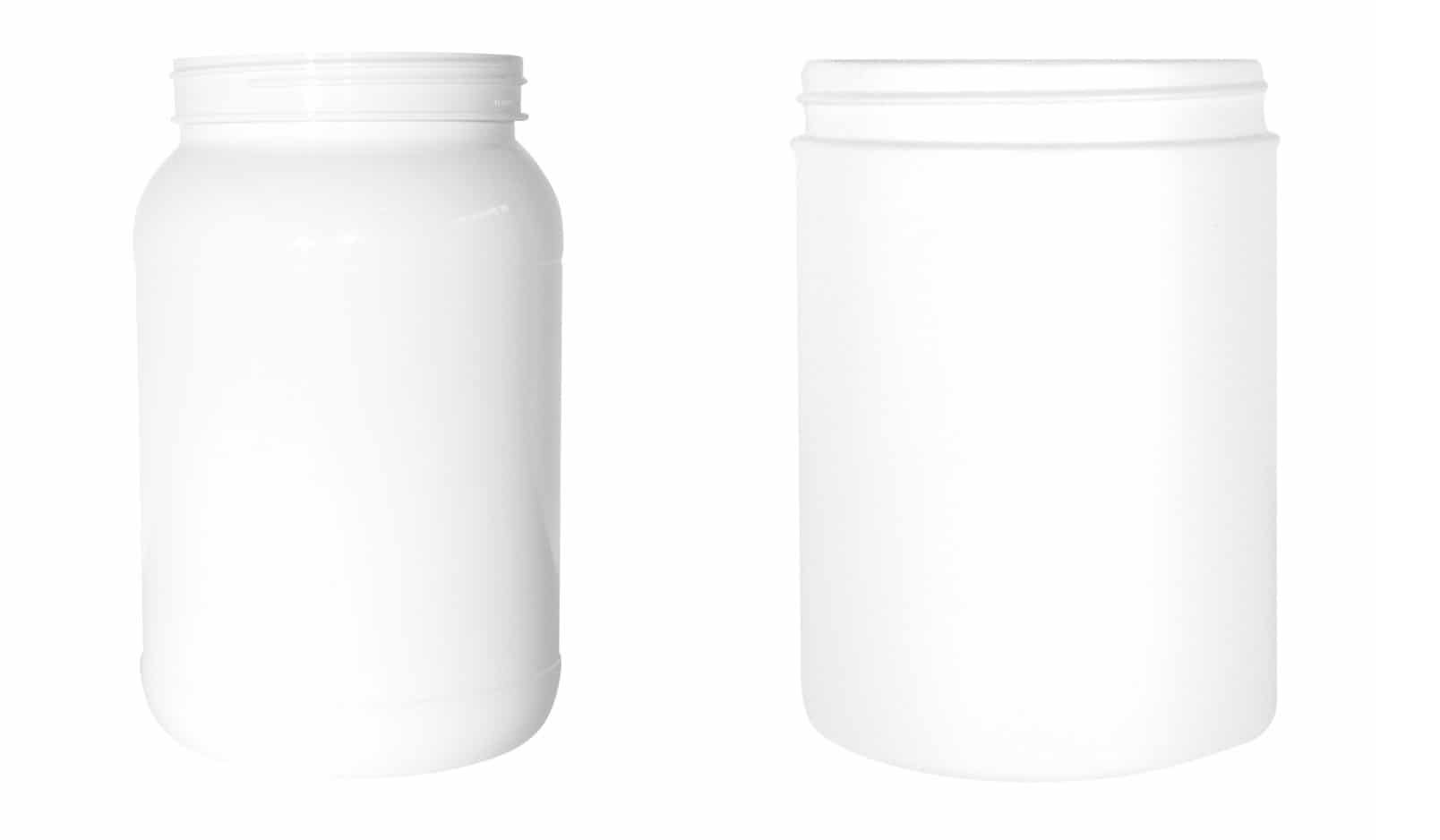
A jar — round or cylinder — holds the same kind of supply in a rigid container, again with an optional scoop. It is the format most people picture when they think of protein or a gainer.
All three hold powder. What differs is who measures the serving, how often air reaches the rest of it, and how much shelf the product occupies for the money.
Sachet, doypack or jar at a glance
| Sachet | Doypack / zip-lock bag | Jar | |
|---|---|---|---|
| The serving is | measured and sealed at the factory | measured by the customer | measured by the customer |
| Fill | 4–12 g per sachet | a course or a month per bag | a course or a month per jar |
| Dosing tool | none needed | scoop | optional dosing scoop |
| Air reaches the powder | once, when the sachet is torn | every time the bag is opened | every time the jar is opened |
| Brand is applied | printed on the paper layer of the laminate | label | label |
| Shelf presence | the carton around the sachets | flat, stands upright | rigid, largest visible face |
| Typically used for | hot drinks, trial packs, courses sold by the day, hygroscopic powders | proteins, gainers, meal replacements, refills | proteins, gainers, meal replacements |
When is a sachet the right answer?
A sachet wins whenever the serving has to be exact without the customer being involved. Nobody levels a scoop correctly at seven in the morning, and nobody does it the same way twice. If your dose matters — because the label states it, because the active is expensive, or because the product is sold as a course — pre-measuring it removes the largest source of variation you do not control.
It wins again when the powder travels. A pouch goes in a bag, a pocket or a hotel drawer; a jar does not. Trial packs, hot drink powders, pharmacy shelves, subscription boxes and anything sold as “one a day for fourteen days” all live in this format for the same reason.
And it wins on protection when the powder is hygroscopic. In a jar or a bag, a month of powder is opened thirty times; in sachets the same month is thirty separate openings of thirty separate portions, and each portion meets the air exactly once. For vitamin C, effervescent blends and anything that cakes in a bathroom cabinet, that is not a marketing point but the reason the format exists. A hot drink powder with vitamin C and calcium is one of the products we have run in this format.
The cost is volume: thirty sachets take more material and more machine time than one bag holding the same powder, and the carton is an extra component on top.
When is a doypack or a zip-lock bag the right answer?
A doypack is the most efficient way to put a large amount of powder in front of a customer. One flexible pouch, one label, one closure, and the powder-to-packaging ratio is the best of the three. For proteins, gainers and meal replacements — where the serving is 25 grams and up and nobody expects precision to the tenth of a gram — the scoop is genuinely good enough.
It is also the format that survives a price comparison. When the buyer is choosing between your brand and another on cost per serving, packaging that does not add much to the total is an advantage rather than a story.
The trade-off is that it is opened daily, it does not protect the contents as well as foil does once the seal is broken, and on a shelf it competes badly with a rigid container next to it.
When is a jar the right answer?
A jar is the format that occupies shelf. It stands, it does not fold, the largest face is a billboard, and in the categories where customers compare products physically it reads as the serious option. It also protects best against crushing and handling in transit, and it is what a sports-nutrition buyer expects to see.
You pay for that in two currencies: volume, because a rigid jar takes far more transport and storage space than a flat bag holding the same powder, and commitment, because a jar plus a scoop plus a label is three components instead of one.
What does the powder decide for you?
More than most brands expect.
Bulk density sets the size. A light, airy powder takes more volume at the same weight than a dense one, so at an identical 8-gram dose it needs a taller sachet or a larger jar. This is why we ask for the formula before quoting a format rather than after: the pouch is picked to fit the product, not the other way round.
Hygroscopicity rules formats out. A powder that clumps in humid air is not a candidate for a container opened daily for a month, whatever the brand deck says. Where a formula is borderline, the sachet is the safe choice and the bag is the risk.
Serving size decides whether a scoop makes sense. Below roughly a teaspoon, a scoop is fiddly and inaccurate and the sachet answers the problem outright. Above 25 grams, a scoop is normal and a sachet becomes an expensive way to package something the customer is happy to measure.
Taste and texture matter at the point of use. A powder meant to dissolve in a glass of water behaves differently from one stirred into a shake, and that is a formulation question we work through together, not a packaging one — see how to choose a supplement form and formula.
What changes on the production side?
The branding mechanism is the biggest practical difference. On a doypack or a jar, the brand arrives as a label, and a design change means a new label. On a sachet, the brand is printed onto the paper layer of the laminate itself, which is why no label is applied — and it also means the printed laminate is ordered as a run, together with the powder batch. Changing artwork after that run is not a label swap.
The second difference is component count. A sachet product is laminate plus carton. A doypack is the bag plus its label. A jar is the jar, the lid, the label and, usually, a scoop. Each component has its own supply chain, and each one is somewhere a first order can grow — which is the real answer to “what is the minimum order”, covered in what makes a first order small by form.
What does not change is the inside. Whichever way the powder leaves the site, it is produced and packed in the same certified facility, and each batch is documented and traceable, with a certificate of analysis.
Do brands really have to pick one?
Most end up with two, deliberately.
The common pattern is a doypack or a jar as the main product for the repeat buyer, and sachets for everything where the customer is not yet a repeat buyer: samples, pharmacy and travel formats, subscription boxes, a fourteen-day introductory course. The formula is identical, which means one development, one batch, two products on the shelf serving two different moments.
The other pattern runs the other way: a sachet course as the flagship, with a bag as the economy refill for customers who already trust the product and no longer need the dose measured for them.
Frequently asked questions
Which powder packaging keeps a serving the most accurate?
A sachet, because the serving is weighed and sealed during production rather than measured by the customer. A scoop in a doypack or a jar is levelled by hand every time, and the variation between users is larger than most brands assume.
Can the same formula be packed in sachets and in a doypack?
Yes. The powder is the same batch either way; what changes is the packaging line and the components. It is a normal way to run one product as two SKUs — a trial format and a supply format.
Which format protects a moisture-sensitive powder best?
A sachet, by a wide margin, because each portion is sealed separately in a laminate with an aluminium barrier and is opened once. A bag or a jar exposes the remaining powder to air every time it is used.
Can I put my own design directly on a sachet instead of using a label?
Yes — that is how sachets are branded here. Printing runs on the paper layer of the three-layer laminate, so the pouch carries your design itself and no separate label is applied. Details are on the sachets page.
Do you supply the dosing scoop with jars and doypacks?
Yes, a dosing scoop is available with both round and cylinder jars and with doypacks. Whether it makes sense depends on the serving size rather than on the container.
Tell us the powder and the serving size
Tell us what the powder is and how large one serving should be, and we will come back with the format that fits it, the options around it and a price list for your volume. We reply within 24 hours — contact us.
Sources
Pharma Manufacture, sachet packing solution — fill weight, dimensions, three-layer laminate and printing on the paper layer: https://pharmamanufacture.eu/private-label-sachets-manufacturer-europe/ (reviewed 2026-09-14)
Pharma Manufacture, packing solutions — the full format list, materials and what each format is used for: https://pharmamanufacture.eu/food-supplement-packing-solutions/ (reviewed 2026-09-14)
Pharma Manufacture, sports nutrition private label — round and cylinder jars, doypacks with optional dosing scoops, certificate of analysis per batch: https://pharmamanufacture.eu/sports-nutrition-private-label-manufacturer-europe/ (reviewed 2026-09-14)