Why Do Tablets Crumble at One Manufacturer and Not Another?
Pharma Manufacture is a contract food supplement manufacturer in Mārupe, Latvia, in the European Union. The pre-compression step this article explains is not theoretical for us — it is how our own tablet press is set up, and the tablets, capsules and softgels it produces are lab tested and released only after quality control. What follows explains why that step matters more than the recipe.
Two manufacturers can press the same formula and send you two different products. One arrives intact. The other arrives with chipped edges and a layer of powder in the bottom of every bottle, and by the time a customer photographs it for a review, the damage is done to your brand rather than to the tablet.
The difference isn’t luck, and it usually isn’t the recipe. It’s how the powder was compressed, and there’s a standard test that measures exactly this.
Key Takeaways
- The European Pharmacopoeia friability test tumbles tablets for 100 revolutions; losing more than 1.0% of their mass is a fail (Ph. Eur. 2.9.7).
- Tablet strength comes from compression control, not from adding more binder.
- Pre-compression before main compression is what keeps weight and hardness steady across a run.
- Ask a manufacturer how tablets are tested and whether each batch ships with a Certificate of Analysis.
How is tablet strength actually measured?
With a drum and a scale. The European Pharmacopoeia’s friability test for uncoated tablets (Ph. Eur. 2.9.7) tumbles a sample of tablets in a rotating drum for 100 revolutions, then removes any loose dust and weighs the tablets again. A loss of more than 1.0% of the mass is generally considered unacceptable.
That’s the whole test, and its bluntness is the point. It doesn’t measure how a tablet feels in the hand or how it looks on the press. It measures whether the tablet survives being knocked around, which is precisely what happens to it inside a bottle on a pallet on a truck.
A supplement isn’t a medicine, and food supplement manufacturers aren’t obliged to run pharmacopoeia methods. But the test exists because the failure mode is real, and a manufacturer who uses it is telling you something about how they think.
Why do tablets crumble in the first place?
Because the powder was never properly consolidated. A tablet is compressed powder held together by the bonds formed when particles are pressed against each other. Too little force, or force applied badly, and those bonds are weak. Air trapped between particles makes it worse, because it has to escape during compression and it leaves voids if it can’t.
There’s a second, sneakier cause: inconsistency. A press that fills each die slightly differently produces tablets of slightly different weight, and weight variation becomes hardness variation. The average tablet may be fine while a portion of the batch is soft enough to break.
That’s why a manufacturer who only talks about tablet hardness is answering half the question. Consistency across a run of hundreds of thousands is the part that decides what your customer actually opens.
What does the press actually do about it?
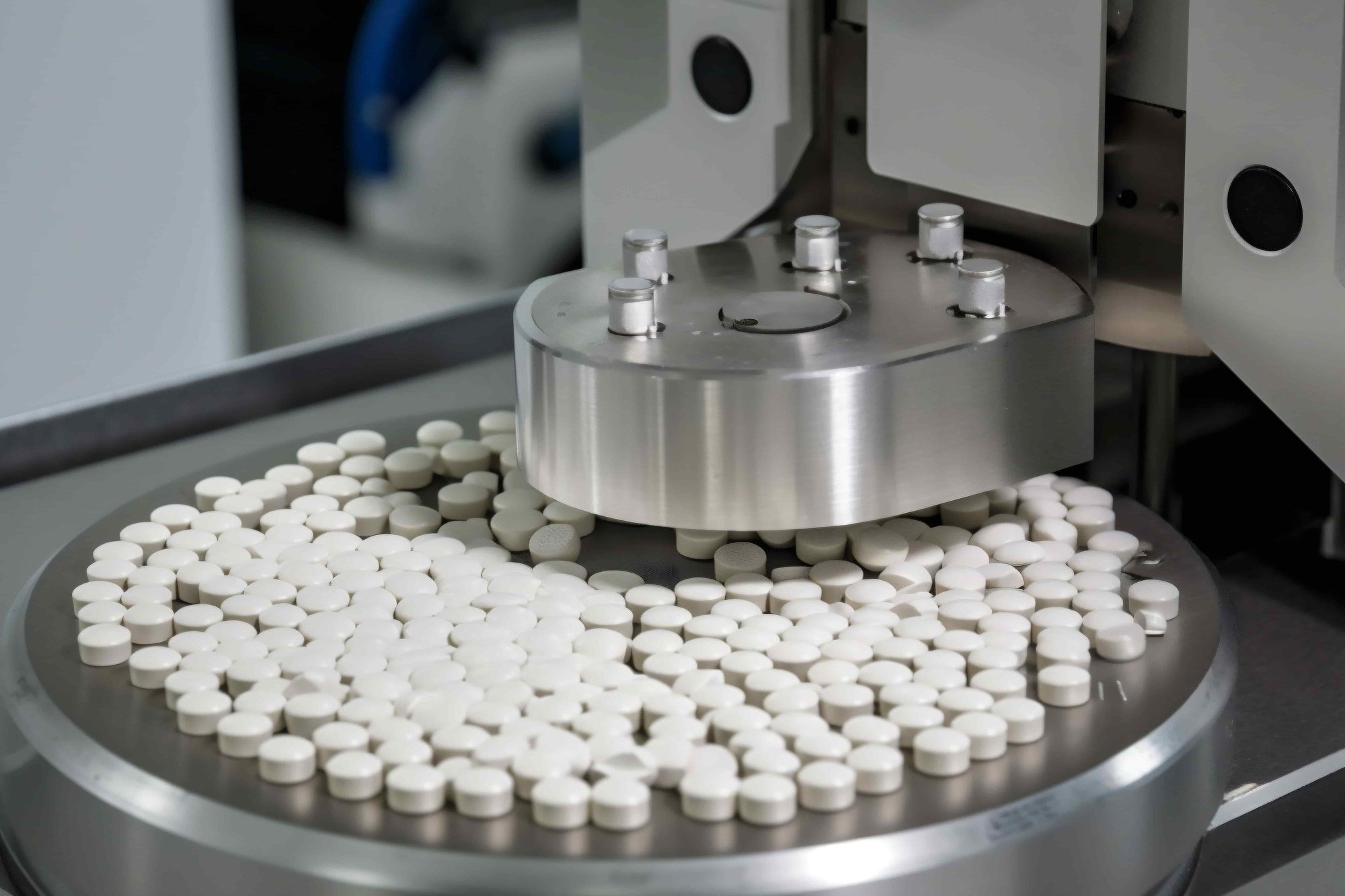
It compresses twice. A rotary tablet press applies a light pre-compression before the main compression stroke. That first pass consolidates the powder and pushes trapped air out of the die, so the main compression works on a stable bed rather than on a loose pile with pockets of air in it.
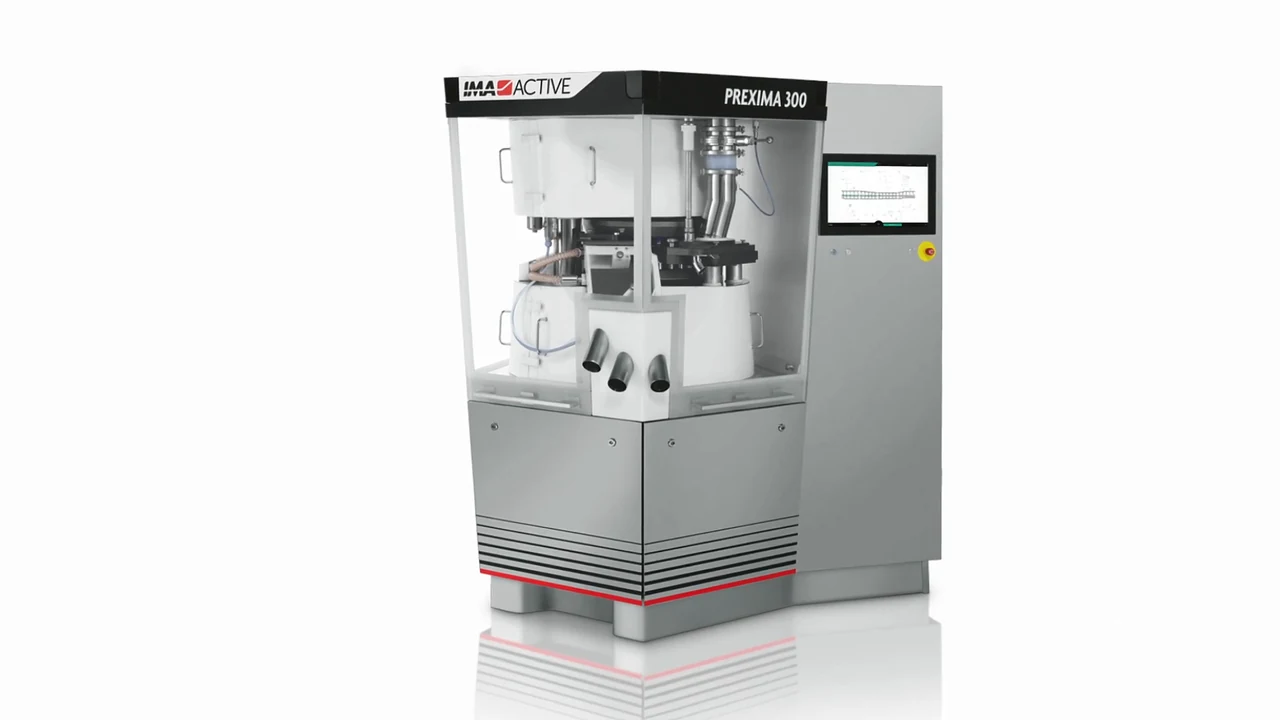
The result is a tablet with more consistent hardness and fewer capping and lamination problems, achieved without changing your formula. Our own IMA PREXIMA 300 works exactly this way, applying pre-compression before main compression on every die, which is what holds weight and hardness steady from the first tablet of a run to the last.
Turret and tooling matter too: they set both the speed and the conditions the powder is consolidated under. Output on that press ranges from 194,400 tablets per hour for 25 mm tablets to 396,000 per hour for 11 mm tablets with IMA 8 tooling, depending on the combination. Anyone who knows those numbers knows what their press is doing.
Can’t you just add more binder?
You can, and it’s the shortcut a lot of products take. More binder produces a harder tablet, and it also produces a tablet that dissolves more slowly, tastes different and carries more excipient per dose. You’ve solved a mechanical problem with a formulation change your customer swallows.
Sometimes reformulating genuinely is the right answer, particularly with difficult botanicals or hygroscopic actives. But it should be a decision, not a default. If a manufacturer’s first suggestion for a fragile tablet is to change your formula rather than the compression profile, ask what they tried first.
The stock versus custom formula guide covers where formulation flexibility actually helps.
What about effervescent and large tablets?
They’re harder, and honest manufacturers say so. Effervescent tablets are big, they’re pressed from a moisture-sensitive blend, and they have to hold together well enough to survive a tube. Large tablets also spread the same compression force over a wider surface, so the pressure per unit area falls.
This is where the machine’s format range stops being a specification and becomes a constraint. A press rated to 25 mm as standard covers effervescent formats and large tablets; one that isn’t, doesn’t. If you’re planning either, that’s a question for the quote stage, and our effervescent tablets page covers what’s involved.
How do you know before the batch ships?
You test, and you get the result in writing. Weight and appearance checks during the run catch drift while it’s still correctable. Laboratory testing of the finished batch, with a Certificate of Analysis, is what turns “it looked fine” into a document you can show a customer or an auditor.
Ask two things. Is every batch laboratory tested, and does it ship with a Certificate of Analysis? A manufacturer who does this routinely will answer immediately, because the answer is a standing process rather than a favour.
For the wider set of questions worth asking before you commit, see our checklist for choosing a contract manufacturer.
Frequently asked questions
What friability figure should I ask for?
The European Pharmacopoeia treats a mass loss above 1.0% in the 2.9.7 test as generally unacceptable for uncoated tablets. That’s the reference point worth knowing, even for a food supplement, because it’s the number the pharmaceutical industry uses for the same failure mode.
Does a harder tablet mean a better tablet?
No. A tablet that’s too hard can fail to disintegrate properly, which defeats the point of taking it. What you want is consistency within a sensible range, which is a compression control problem rather than a “press harder” problem.
Why do my tablets look fine but arrive damaged?
Because handling is the test. Tablets that pass visual inspection on the line can still fail once they’re tumbled together in a bottle through transport, which is exactly what the friability drum simulates. If your product travels, that’s the property that matters.
Is capping the same thing as crumbling?
Not quite. Capping is when the top of a tablet separates as a disc, usually from air trapped during compression. Crumbling and chipping are edge failures from weak bonding. Both are compression problems, and pre-compression helps with each.
Can you fix a crumbling tablet without changing the formula?
Often, yes. Compression profile, tooling and press speed all move tablet strength before anyone touches the recipe. Reformulating is a valid tool, but it shouldn’t be the first one reached for.
Ask us how your tablet would be pressed
Pharma Manufacture is a contract food supplement manufacturer in Mārupe, Latvia, in the European Union. The press, its pre-compression, its rated outputs by tablet size and its maximum diameter are published on the equipment page, alongside the rest of the line.
If you have a tablet that’s been fragile at another manufacturer, tell us the formula, the size and what went wrong. We’ll tell you what we’d change and what we’d leave alone. Get in touch and we’ll usually reply within 24 hours.
Sources
European Pharmacopoeia, chapter 2.9.7 Friability of uncoated tablets (100 drum revolutions; mass loss above 1.0% generally considered unacceptable), retrieved 2026-07-21: https://www.drugfuture.com/Pharmacopoeia/EP7/DATA/20905E.PDF
IMA Active, PREXIMA rotary tablet press product page (pre-compression and main compression, rated outputs by tooling and tablet diameter, maximum tablet diameter), retrieved 2026-07-21: https://imagroup.com/machines/prexima/